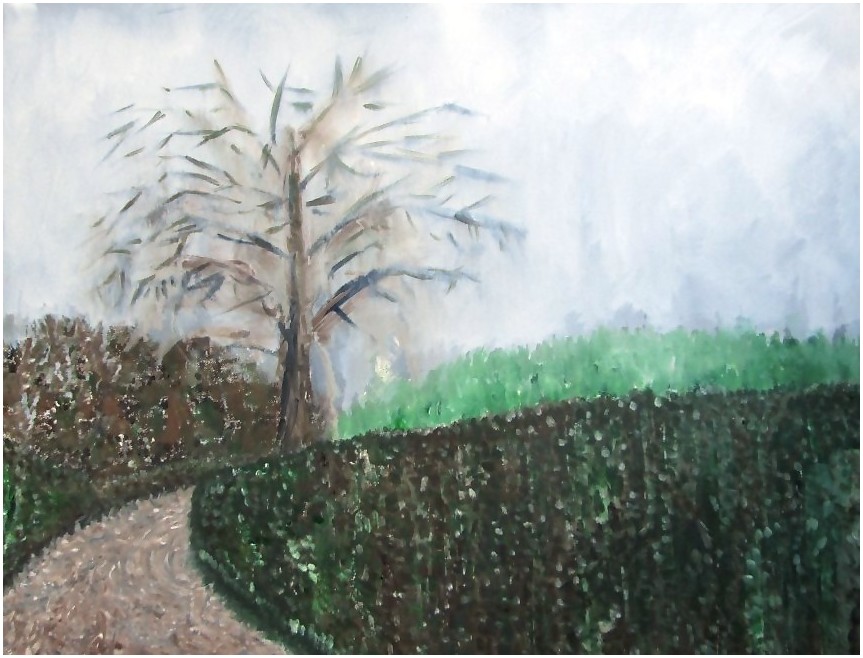
‘I don’t want to save the World, I don’t even want to save me. We’re so boring that we don’t even want to save ourselves… There’s nothing left to say, we’re so fucking boring. Let it die I say. Let there be a new beginning… It’s awful. Goodnight!’ ~ Charles Bukowski
return to the fields
A bit about my journey…
I grew up in a council house in the village of Christow, east Dartmoor, overlooking a beautiful valley we simply referred to as the fields where we would spend many an hour building tree houses, attempting ninja moves, swimming in rivers and exploring the terrain free as birds. The fields seemed a world apart from the village, with all its snobbery and rules, and in many ways to us harboured mysteries akin to ancient myths and folklore. I was creative as a child; I particularly enjoyed drawing cartoons and was very good at theatre. My parents also like to remind me about the time I “Jackson Pollocked” their bedroom with mum’s nail varnish! The village was largely middle class and well-to-do but there was a minority assortment of low-earning “riff-raff”, which I suppose my family fell into (and probably why my accent confuses a lot of people because I don’t sound like a Devonshire dumpling who says “ooh-arr”). Dad was a jobbing builder and mum worked mostly as a school secretary around other jobs cleaning and babysitting. It was Thatcher’s ’80s so tough times for those in the low-income bracket living in rural areas but, although my parents struggled a lot financially (divorcing when I was quite young), Dartmoor was an amazing place to have spent a childhood. The wonderful feeling of freedom amid nature experienced by my brother, friends and I remains, I think, the single biggest influence behind my work.
I was an anxious and rebellious indie-kid coming of age in the ’90s via underachieving at a small-town comprehensive (beaten up and kicked out of home, aged 16, during my GCSEs but that’s another story!) and working various part-time jobs to earn money that was mostly spent on t-shirts, weed and cassettes. Early on it was all things indie and grunge – from Senseless Things, Ride, the Cure, Nirvana and L7 (and outrageous shows like The Word) to the dub and spaced-out electronica of Mad Professor, Dub Warriors and the Orb. I remember discovering the golden era of hip hop from A Tribe Called Quest and the Beastie Boys to Public Enemy and the punkish gangtsa rap from groups like NWA. It was BMX, skateboards, Super Nes and Street Fighter 2 in an era of Strictly Jungle and the Edge mixtapes, late night cruising country back roads of Devon (usually to a free party), high as kites and trippin’ on shrooms, bopping to the drum n bass riddims of Hype, Nicky Blackmarket, Micky Finn, Darren Jay and more! Most of all, I’ll never forget the first time I heard Demon’s Theme on LTJ Bukem’s Logical Progression compilation; it blew my mind and got me into DJing! There was Bristol’s trip hop and d’n’b scene from Massive Attack to Roni Size’s Full Cycle Records. There was the time we got loved-up to see Leftfield’s Paul Daley do a set at Plymouth Warehouse (with Fabio playing jazzy drum n bass in the back room) and my first crowd surf was at a Prodigy gig on speed. We had music with energy, diversity and spirit that made it genuinely exciting to be young.
An itinerant teen on benefits, via Kingsteignton, Ogwell and Newton Abbot, I moved to Exeter (into various house shares) to attend college where I encountered the barminess of Brit Art while visiting the now infamous Sensation exhibition at the Saatchi Gallery. I recall being particularly drawn to the paintings of Chris Ofili and Fiona Rae. It was around this time that I realised the dream was to be an artist (specifically an abstract painter). The creative culture of the ’90s – in all its pioneering, self-sufficient optimism, eccentricity and romance – spoke to that rebellious teenager inside who, through youthful naivety, believed the 21st century would play host to an even greater spirit of indie!
After college I lived rent-free in a village pub in Doddiscombsleigh while working in the bar and kitchen, deferred a place at uni, saved some money and travelled Australia and New Zealand. I attained a bachelor’s from the Nottingham Trent University and later got my MA at Central Saint Martins, London (also making various trips around Europe whenever I could, visiting numerous galleries and museums). The former I spent most of my time in record shops, spinning a mixture of dub and intelligent drum n bass on Nottingham’s Fly FM and various bars and clubs, disinterested in my arty-farty contemporaries promulgating postmodernism’s arid worldview. I had lots of fun working part-time in a small bistro run by an old rocker and in my second year I undertook a collaborative project with Nottingham’s Royal Society for the Blind, which got me short-listed for an Ambassadorial Scholarship. At the time I was hoping to study a master’s in California, but sadly it wasn’t meant to be. Yet still I dreamed and ultimately headed to London where I discovered that an idealistic council house boy from Dartmoor would come to find the art scene, in such a cosmopolitan city that had been so creatively vibrant only a decade earlier, boringly fauxhemian (the result of too much gentrification, maybe). I found it all a bit sterile and institutionalised. The Big Smoke excited me no end during my late teens and early twenties but, after seeing more of the world before eventually moving there, I found it to be a noisy, overpriced, suffocatingly corporate shithole, rather than a global city with any kind of artistic or cultural vibe.
My time in Nottingham saw two wars of questionable legality and I fell increasingly into disillusionment, as much with the apathy of largely privileged university students as society in general. After London came the financial crash, which only compounded my anger and despair towards the world. Art seemed indulgent, impotent and pointless… I realised I needed the space and quietude of the fields.
The ensuing experimental, melancholic and disenchanted years eventually led to a return to my roots, mainly through a desire to reconnect with nature. I found myself becoming interested in the mysterious and numinous qualities of landscapes, particularly the areas around Dartmoor not far from where I was living in Exeter, drawing from various Devonian folktales alongside the work of Jung, Eastern philosophy and art of the early modernists. I ran a couple of studios, which I mostly supported through an assortment of jobs including night shifts in a care home for adults with autism and learning disabilities to working for mental health crisis teams and teaching English at a language school. I took part in solo and group exhibitions in both the UK and abroad. However, I found the creative process itself is what intrigues me: gallery shows seemed rather dull, so I eventually ended up leaving work in random places – be it cities from Plymouth, Bristol, London and Paris to rural locations around Devon. During this time, writing was becoming the primary focus of my creative endeavours culminating in my first novel, written in various cafes, followed by a two-month road trip through Morocco, Spain and Portugal. I then wrote my first book of poetry while living on Dartmoor, mountain-biking through its glorious woodland, before moving again.
I became fascinated with the folk tradition and coastal landscapes of Cornwall after moving from Dunsford to Falmouth in 2020 to study boatbuilding. No idea why I wanted to pursue this – I’ve sailed maybe a handful of times in my life! I think I was drawn to boats as an object and liked the idea of working with them sculpturally. I quickly discovered I’m no mariner and switched to studying a personal training qualification, simultaneously working a mixture of jobs in cafes, pubs, psychiatric wards and a homeless hostel. I completed the course despite fracturing my ankle after taking up surf-skating, which was shortly followed by the death of my grandfather (amid the lockdown insanity). On my fourth attempt, I passed my driving test in Camborne and then headed back east to Devon, relocating to Exmouth, where I attained an exercise referral qualification while working as an Activities Coordinator for a mental health charity. I also began writing a new novel inspired largely by Homer’s Odyssey and fairy tales of the Brothers Grimm. It’s still in the early stages, but I may post some extracts in due course as it develops.
I began studying a master’s in psychology while living in Exmouth and switching jobs to an NHS crisis house in Exeter. However, I got halfway through and found the whole subject rather soulless and overly feminised. Indeed, I learned that 96% of psychological research is done in Western countries, predominantly American universities, whose participants are mostly white, female students from relatively affluent backgrounds. So much for diversity (almost as bad as the arts!). I also took issue with its claim to science through a comparatively lax p-value. I found it too much of a chore studying a master’s around full-time shift work in the NHS, which involved hours of reading dry academic journals where I felt the “research” was telling me shit that was self-evident (for certain, my years working in mental health have taught me more about the pervasive nature of despair than anything I’ll learn at university!). During this time, my money-grabbing landlord decided to evict us so he could develop his property into luxury flats. The stress led to being prescribed anti-depressants by my doctor… not for the first time, although this one actually worked (for a while).
I moved to the small village of Tedburn St. Mary (where I reside as of writing, shortly before moving again to Teignmouth: where the valley I grew up meets the sea, I have a view of distant clouds beyond its horizon, and can feel the sand beneath my feet). I then read an interview with German film maker, Werner Herzog, who was critical of psychoanalysis. I can’t recall the exact way he put it but he alluded to the soul as being like a house – if every part of it was illuminated, it would be uninhabitable. He considered it to be equally true of the soul that some darkness is necessary, which runs contrary to the aim (in his opinion) of psychoanalysis. I found myself agreeing with him, which made me realise that if I agree with such a view then I am probably not going to make a very good therapist. It’s oddly reflective of how art has lost its implicit qualities: these days, everything needs to be explained! I faced up to the fact that I had simply lost the confidence to pursue dreams of being a writer (after more rejections for Adrift in Amnesia and The Cycle Diaries than I care to count!). I jacked in the master’s and got back to work.
All the above, coupled with my love of underground dance music, helped coin the term dub spectrum, which is a creative ethos primarily focusing on writing and lens-based media. It embraces self-sufficiency, drawing from the DIY approach of underground music movements, which sees creativity as a counterbalance to the cold and corporatised rationalism that seems to be driving the entire world mad. My work orientates largely from the tension between Blake’s innocence and experience and the idea that once the energy of imagination is used effectively to realise the connection between man and nature, the individual gains freedom from the restrictive bonds of unimaginative thought.
An art student in the early noughties, I was initially optimistic about Big Tech’s brave new world connecting us all. For a time, this seemed to have real potential – finally releasing creatives from the shackles of the gatekeepers, ushering in a new era of indie. I collaborated with artists, writers and musicians as far afield as the US, Russia and Thailand, but also connected with people who were simply interested in art and were drawn to my work. However, in the last 10-15 years, something has darkened to the point of being weirdly uniform, insular and polarised (curiously coinciding with the rise of iPhones and social media colonising our lives). The nineties feel like a distant memory. Britain no longer feels like a creative country. There is no joy in our disembodied tech malaise. Now is surely one of the most depressing times to be a writer (and artist)… be it facing the totalitarianism of AI, the abject and perpetual nihilism of the Internet, the Americanisation of everything, the absurdity of a pathologically ecocidal and banal consumerism (not least in its commodification of protest), or the mind-numbing conformity of a bourgeois arts scene kowtowing to the egocentric demands of entitled, terminally online activists: cultural homogenisation jacked up to the max in a linear society. It has all become so fucking boring, politics is killing the arts… let it die I say! Let there be a new beginning. G.K. Chesterton once wrote that a dead thing can go with the stream, but only a living thing can go against it. I try to remember those words whenever I look at the world and feel my dreams fading to despair. A new journey begins with a return to the fields.
2025
dub spectrum