return to the fields
'Ever tried. Ever failed. No matter. Try again. Fail again. Fail better.' ~ Samuel Beckett (Worstward Ho)
a bit about the journey…
I grew up in a council house in the village of Christow, east Dartmoor, overlooking a beautiful valley we simply referred to as 'the fields' where we would spend many an hour building tree houses, attempting ninja moves, swimming in rivers and exploring the terrain free as birds. The fields seemed a world apart from the village, in all its rules and gossip, and in many ways to us harboured mysteries akin to ancient myths and folklore. I was creative as a child; I particularly enjoyed drawing cartoons and was very good at theatre. My parents also like to remind me about the time I 'Jackson Pollocked' their bedroom with mum’s nail varnish! The village was largely middle class and well-to-do but there was a minority assortment of low-earning 'riffraff', which I suppose my family fell into (and probably why my accent confuses a lot of people because I don’t sound like a Devonshire dumpling who says 'ooh-arr'). Dad was a jobbing builder and mum worked mostly as a school secretary around other occupations cleaning and babysitting. It was Thatcher’s '80s so tough times for those in the low-income bracket living in rural areas but, although my parents struggled a lot financially (divorcing when I was quite young), Dartmoor was an amazing place to have spent a childhood. The wonderful feeling of freedom amid nature experienced by my brother, friends and I remain, I think, the single biggest influence behind my work.
I was an anxious and rebellious indie-kid coming of age in the '90s via underachieving at a small-town comprehensive (beaten up and kicked out of home, aged 16, during my GCSEs but that’s another story) and working various part-time jobs to earn money that was mostly spent on t-shirts, weed and cassettes (it will come as no surprise that I only got two GCSEs!). Early on it was all things indie and grunge – from Senseless Things, Ride, the Cure, Nirvana and L7 (and outrageous shows like The Word) to the dub and spaced-out electronica of Mad Professor, Dub Warriors and the Orb. I remember discovering the golden era of hip-hop from A Tribe Called Quest and the Beastie Boys to Public Enemy and the punkish gangtsa rap from groups like NWA. It was BMX, skateboards, Super Nes and Street Fighter 2 in an era of Strictly Jungle and the Edge mixtapes, late night cruising country back roads of Devon (usually to a free party), high as kites and trippin’ on shrooms, bopping to the drum n bass riddims of Hype, Nicky Blackmarket, Micky Finn, Darren Jay and more! Most of all, I’ll never forget the first time I heard Demon’s Theme on LTJ Bukem’s Logical Progression compilation; it blew my mind and got me into DJing! There was Bristol’s trip hop and d’n’b scene from Massive Attack to Roni Size’s Full Cycle Records. There was the time we got loved-up to see Leftfield’s Paul Daley do a set at Plymouth Warehouse (with Fabio playing jazzy drum n bass in the back room) and my first crowd surf was at a Prodigy gig on speed. We had music with energy, diversity and spirit that made it genuinely exciting to be young (and I'll remain a combination of Stussy, Vision Street Wear and '90s d'n'b till I die!).
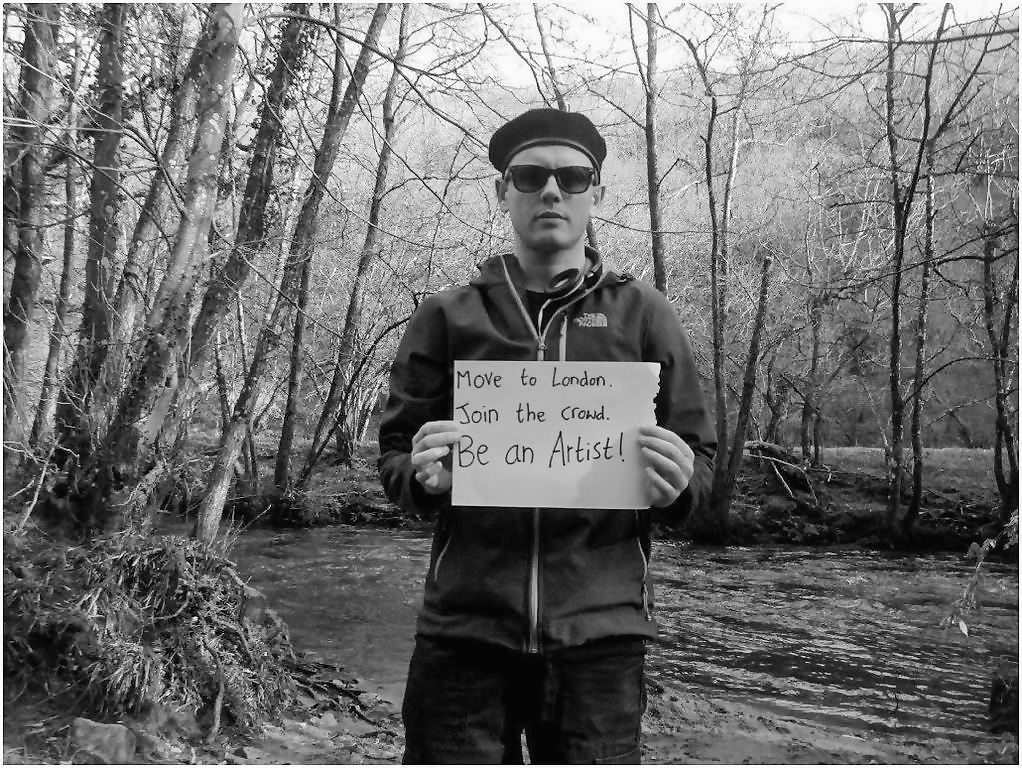
For a while I felt alienated from both parents before a process of reconciliation, which took longer with my father (I felt unable to see him for three years). Despite dropping out of college twice while moving around a lot – not to mention frequently getting drunk, high, partying and waking up at least once in a police cell with no memory of how I got there – I managed to acquire three more GCSEs and build a portfolio to get me into Exeter College's respected Art Foundation course with bare minimum qualifications and not fall behind my year. It was fun but I nevertheless felt quite behind my posh peers with their A-levels and pretentious ideas. Still, I managed to be the first student on the course to secure a place at university (Cardiff), which I turned down due to having my heart set on London – a city that excited me no end at the time. Unfortunately, none of its snooty art schools would give me the time of day. It wasn’t that I couldn’t draw or paint as competently as my peers; coming from a different background, I hadn’t developed the ‘art-speak’ or posturing required to get me past the gates. An itinerant teen on benefits, via Kingsteignton, Ogwell and Newton Abbot, I moved to Exeter (into various house shares) while attending college where I encountered the barminess of Brit Art at the Saatchi Gallery's infamous Sensation exhibition. I recall being particularly drawn to the work of Chris Ofili, Sarah Lucas and Fiona Rae. It was around this time that I realised the dream was to be an artist (specifically an abstract painter). The creative culture of the '90s – in all its pioneering, self-sufficient optimism, eccentricity and romance – spoke to a young, directionless failure who, through youthful naivety, believed the 21st century would play host to an even greater spirit of indie!
After college I lived rent-free in a quaint village pub in Doddiscombsleigh while working in the bar and kitchen, deferred a place at uni, saved some money and travelled Australia and New Zealand. I attained a bachelor’s from the Nottingham Trent University and later got my MA at Central Saint Martins, London (also making various trips around Europe whenever I could, visiting numerous galleries and museums). The former I spent most of my time in record shops, spinning a mixture of dub and intelligent drum n bass on Nottingham’s Fly FM and various bars and clubs, disinterested in my arty-farty contemporaries promulgating postmodernism’s arid worldview. I had lots of fun working part-time in a small bistro run by an old rocker and in my second year I undertook a collaborative project with Nottingham’s Royal Society for the Blind, which got me short-listed for an Ambassadorial Scholarship. At the time I was hoping to study a master’s in California, but sadly it wasn’t meant to be. Yet still I dreamed and ultimately headed to London where, unfortunately, I discovered the ‘other story’ would inspire a deep sense of anxiety and melancholy within.
A darkness began to take hold while I was an undergrad in Nottingham. At first, I put it down to feelings of anger towards the world the more its workings became apparent. However, I would discover it to be more existential – an elusive melancholy fused with a return of anxiety far more debilitating than what I had experienced in my teens; a feeling I can only describe as a terrifying sensation of the infinite. By the time I got to London I was considerably depressed and introverted, which did not make good bedfellows for one aiming to succeed in the arts! It was a very alienating experience, and I contemplated suicide many times. Medication and therapy were not much help, although eventually I was able to overcome the worst of the anxiety, mainly by exposing myself to it, in this case wide open spaces after developing agoraphobia, which was exhausting.
I began counselling while studying a master's at Saint Martins, which dredged up a lot of past experiences that were tough to reconcile with personal aims in the present. While all of this was going on I had to try to live: pay rent, get a job, pay off my student debts etc. Needless to say, networking London's hopelessly posh, fashionable art scene with my head lost in an interminable fog felt like being in an alien world, I didn't identify with any of it – a view only compounded by indifference and repeated rejection (such is the arts). Much like a working-class teen booted out of home, I remained a restless and directionless failure. Still, for whatever reason, the only light amid all this was being creative (to be honest, there was little else about the world that held any real interest for me) and I suppose it would be such glimmer with a sense of self-reliance that gradually evolved into dub spectrum.
The ensuing experimental, melancholic and disenchanted years embodied a process of 'unlearning' after graduating from university, which eventually led to a return to my roots. I ran a couple of studios in Exeter that I mostly supported through an assortment of jobs including night shifts in a care home for adults with autism and learning disabilities to working for mental health home treatment teams and teaching English at a language school. The single-minded determination to be an abstract painter gradually evolved into working with the figure (with a particular interest in Matisse), which led to a specific interest in landscapes after reading Eastern philosophy and the work of Jung in tandem with the aforementioned exposure to open spaces. I came to see landscapes as a metaphor expressing the terrifying beauty of the infinite: the awe and dread of Rudolf Otto's mysterium tremendum that laid the foundation for Jung's idea of the numinous. I took part in solo and group exhibitions in both the UK and abroad. However, I found gallery shows were rather dull, so I eventually ended up situating work in different locations – be it cities from Plymouth, Bristol, London and Paris to rural areas around Devon (in hindsight, I realise this formed as much a part of my confrontation with the infinite as an artistic engagement with it). Painting would eventually fade into the background as writing became the primary focus of my creative endeavours, culminating in my first novel written in various cafes, followed by a two-month road trip through Morocco, Spain and Portugal.
It was early 2019 when my nan passed away after a long battle with Alzheimer’s. My uncle is on the spectrum; he’d lived with her all his life and had never been on his own. I moved to the small village of Dunsford on Dartmoor to keep him company. Here, I wrote my first book of poetry inspired by mountain-bike rides through some of my favourite woodland located in the village's backyard (and marking the beginning of my interest in embodied poetry). My stay was only supposed to be temporary but then lockdown happened. I was working in an independent café in Exeter at the time. The owner sorted furlough pay for his staff so I spent a glorious spring of 2020 walking and mountain-biking through the woods while the rest of the world lost its mind, during which I also managed to attain a level 2 qualification in gym instructing (I started the course a couple of months before lockdown; the tutors continued to deliver pre-recorded lectures and we submitted coursework before taking the practical assessment when restrictions eased).
After receiving a tonne of rejections for both of my books, I began to feel quite depressed at yet more failure and seriously started to wonder if this is what will end up defining me (incidentally, given how interminably woke the publishing industry appears to be, and me being a cis-white-male villain, I’d be lying if I said I had never entertained the idea of telling agents and publishers I was a lesbian transwoman of colour to see if I'd have better luck. Thankfully, I haven’t got that desperate – yet!). Lockdown one was coming to an end, so I decided to head west with the intention of forgetting the utterly foolish idea of being an artist and writer.
I moved from Dunsford to Falmouth in 2020 to study boatbuilding. No idea why I wanted to pursue this – I’ve sailed maybe a handful of times in my life! I think I was drawn to boats as an object and the freedom of the sea. I quickly discovered I’m no mariner and switched to studying a personal training qualification supporting myself through a mixture of jobs in beachside cafes, pubs, psychiatric wards and possibly the most chaotic homeless hostel in all of Cornwall. I completed the course despite fracturing my ankle after taking up surf-skating, which was shortly followed by the death of my grandfather (amid the continued lockdown malaise). On my fourth attempt, I passed my driving test in Camborne. I then headed back east to Devon, relocating to Exmouth, where I attained an exercise referral qualification while working as an Activities Coordinator for a mental health charity before going to work for the NHS at a crisis house helping people experiencing psychological distress (I am interested in how a combination of creativity, movement and time spent in nature can aid recovery, although I avoid the term ‘therapy’!).
I began studying a master’s in psychology in lieu of the dream. However, I got halfway through and found the whole subject rather soulless and overly feminised. Indeed, I learned that 96% of psychological research is done in Western countries, predominantly American universities, whose participants are mostly white, female students from relatively affluent backgrounds. So much for diversity (almost as bad as the arts!). I also took issue with its claim to science through a comparatively lax p-value. Working in mental health is interesting, but I realised there’s no way I could entertain the same kind of questionable science if I were an engineer building planes. During this time, my money-grabbing landlord decided to evict us so he could develop his property into luxury flats. The stress led to being prescribed anti-depressants by my doctor... not for the first time, although this one actually worked (for a while).
From Exmouth, I moved to the village of Tedburn St. Mary; I continued studying a master's around full-time shift work in the NHS only to find my foolishness reawakened! I bought a camera and started to reacquaint myself with various photography techniques (balance, rule of thirds etc) while getting to grips with Adobe Lightroom Classic. I wanted to haunt the woods and was finding it increasingly difficult to fit a part-time master's around 13-hour shifts and my newfound urge to be creative. I realised I wasn't keen to sit in front of a laptop on my days off attending lectures delivered by badly written PowerPoints, nor reading dry academic journals where I felt the 'research' was telling me shit that was self-evident. Something had to give. I then read an interview with German film maker, Werner Herzog, who was critical of psychoanalysis. I can’t recall the exact way he put it, but he alluded to the soul as being like a house – if every part of it was illuminated, it would be uninhabitable. He considered it to be equally true of the soul that some darkness is necessary, which runs contrary to the aim (in his opinion) of psychoanalysis. I found myself agreeing with him, which made me realise that if I agree with such a view then I am probably not going to make a very good therapist! It’s oddly reflective of how art has lost its implicit qualities, nowadays everything needs to be explained. I faced up to the fact that I had simply lost the confidence to pursue dreams of being an artist and writer (after more rejections for Adrift in Amnesia and The Cycle Diaries than I care to count).
I jacked in the master’s and returned to a fool’s journey before buying my first flat in Teignmouth, where the valley I grew up meets the sea and which I decorated in colours inspired by Jardin Majorelle after visiting it in Marrakech. I have since been focusing primarily on writing fiction and poetry alongside photography and film that incorporates an embodied experience amid nature with poetry and haiku (in the midst of shifts, can't give up the day – and night – job just yet!). Nowadays, the arts strike me as coming from an increasingly limited scope of thought while becoming ever more intolerant (mirroring the Right), which is why I think a return to indie is relevant.
All of the above helped coin a term that considers art a version of something (dub) with infinite possibilities (spectrum) through a creative system with both a DIY ethos and aesthetic inspired by the underground music I grew up around in the '80s and '90s. Part realisation of being an artistic outsider, part realisation of not wanting to be involved in a stupid culture war's 'politicisation of everything' that changes fuck all; dub spectrum endeavours to reconnect with an indie spirit lost in 21c's linear society that appears to have given rise to an increasingly literalistic culture as detrimental to truth as it is to art and the imagination. I'm not sure what that leaves us with. dub spectrum holds some similarities to English Romanticism and what the Japanese refer to as 'yutori' (meaning 'spaciousness') and 'wabi-sabi' (finding elegance in the implicit qualities of transience and imperfection). Walking is a source, especially in the woods: trees retain an enduring mythical, not to mention existential, symbolism and I am interested in how historically people have attempted to connect with the enigmatic spirit of nature through an embodied experience. I write poetry and fiction under a pseudonym, Percival Alexander, which began as prose pieces incorporated into paintings on plasterboard that developed into themes of despair and transformation in a fractured world – almost as if different creative avenues access different parts of the soul. I am not entirely sure how this relationship came to be but nevertheless embrace the idea of art as resistance by way of re-enchantment. Extracts from my debut novel Adrift in Amnesia can be found here. Details of my first book of poetry The Cycle Diaries can be found here. I am currently working on my second novel – a fairy tale adventure about two lovable cats in search of a new home – and may share some posts of its development.
In the meantime, I’ll fail better.
2026
Christopher Sharp