'The clearest way into the Universe is through a forest wilderness.' ~ John Muir
Nemophilist
/nᵻˈmɒfᵻlɪst/
noun
‘a haunter of the woods.’
Embodied poetry is in large part an evolution from Christopher's second book (written under a pseudonym), The Cycle Diaries, which drew heavily from the interrelationship between existentialism and movement. He is interested in developing an integrated methodology of poetry into storytelling initiated by a connection he feels, in particular, to woodland areas of Dartmoor’s Teign Valley where he grew up. The woods are depicted as liminal spaces in fairy tales opening the way for personal transformation, often as a place of danger as the character leaves the familiarity and safety of civilisation, which he finds intriguing. Visually, he aims for an atmosphere of mystery and melancholy, like that captured in early cinema's silent black and white movies. Compositionally, he draws inspiration from ancient Chinese painters, such as Ma Yuan and Guo Xi, while considering the Japanese concept of ‘ma’ (negative space) to explore absence among form as an integral part of the subject. He takes a notepad with the intention of complementing each picture of various scenes, sketched through the written word while taking long walks laying the basis for a poem or haiku, which sort of mirrors the technique of shooting an image in RAW before post-processing.
Christopher describes his approach as follows: ‘In some ways, my technique is “anti-photography” in its emphasis on emptiness being integral to the subject. I suppose one option could be to present a series of blank images but this would be an all-too-obvious reference to previous artistic concepts and methods, which are irrelevant to the process, while negating embodiment and the idea of emptiness as paradoxical, hence my interest in fairy tales, ancient Chinese landscapes and Eastern philosophy in the context of woodland scenes being at once empty and transformative; as mysteries concealed in stories partially revealed.’
When presenting intertitles alongside the images, he prefers to use an Art Deco style of font (such as Limelight or Broadway) to reference early cinematic influences, which he also feels add to a kind of tension between nature and modernity. Influenced largely by the soundscapes of drone and dub techno, he aims to present his images with on-site field recordings and spoken word to create an immersive experience. He hopes to exhibit a body of work in 2027.
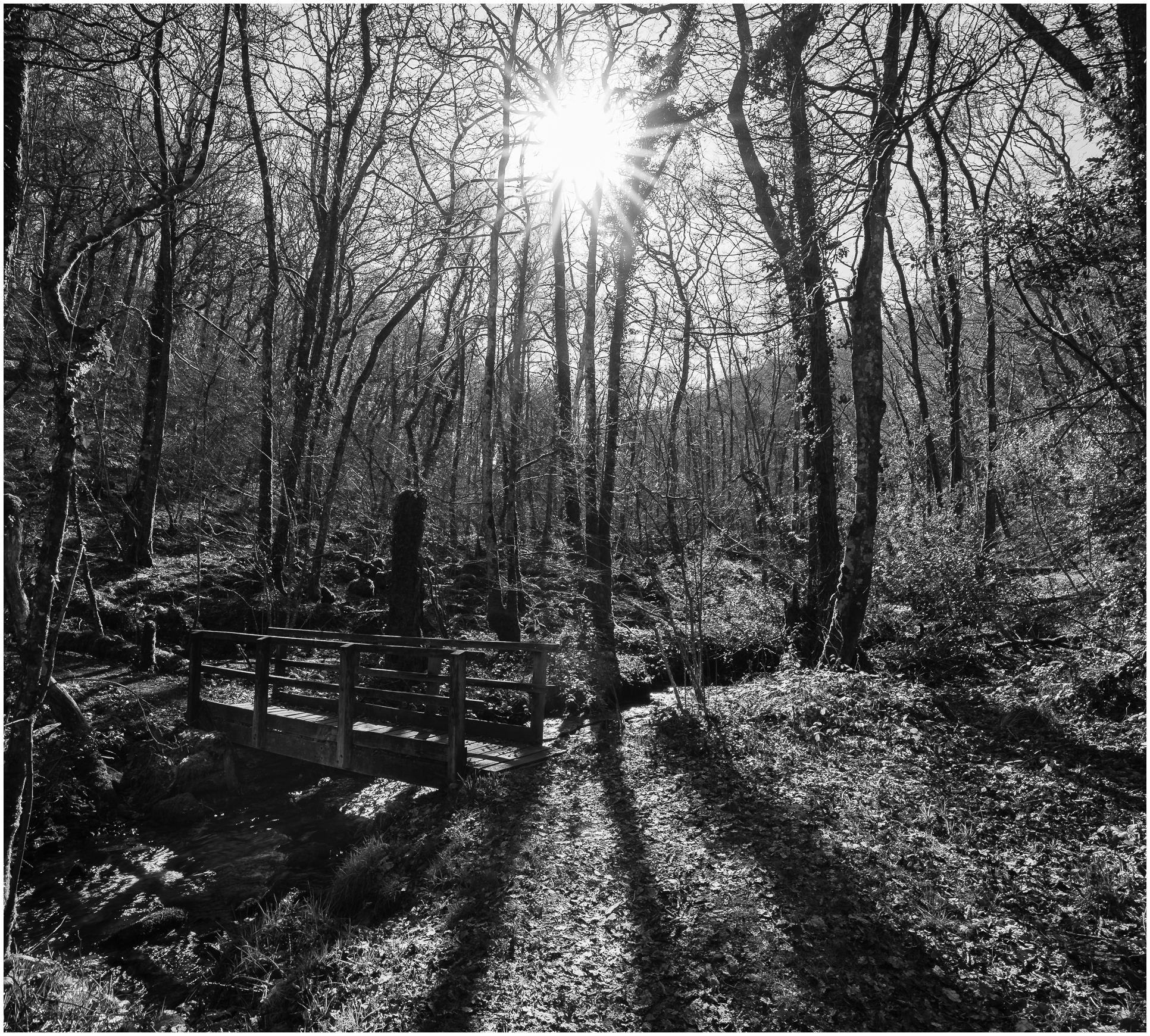
Thomas Cleave Wood
dead leaves
pass under
the bridge
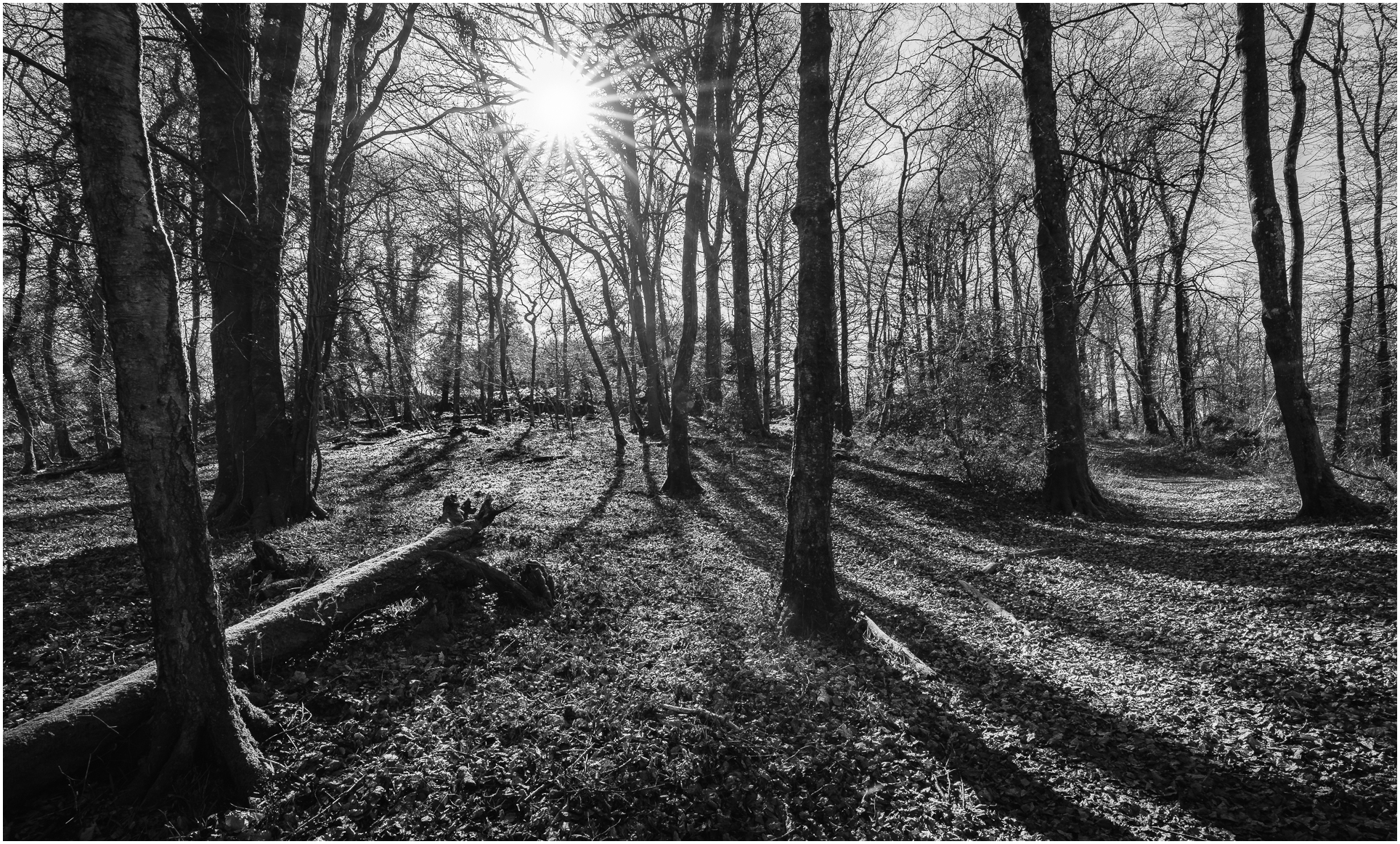
Bridford Wood
shadows cast over
broken twigs on woodland path –
the afternoon sun
Christopher is also exploring embodied poetry through silent, monochromatic films.