‘I feel like we are nearing the end of times.’ ~ Hayao Miyazaki
dub spectrum and ai
People are often surprised to discover that I have never used Copilot or ChatGPT. Writing is a skill and I consider myself pretty decent and feel it’s something that can always be improved upon so best to keep practising – whether writing creatively, emailing a friend or colleague, or typing up a patient’s note at work. I feel the more we lose touch with the skills we have – be it writing, playing a musical instrument or carpentry – not only do we risk losing touch with ourselves, but also risk giving away our autonomy (in a world where such a thing is rapidly diminishing!).
I have experimented a little with the AI denoise tool in Lightroom and thought it was a bit crap – putting a bland sheen over the character of human faces… as if programmed to understand cultural homogenisation as representing the highest art: no uniqueness, no eccentricity, no mystery, no beauty, no personality; just a standardised sheen of bland (like those freakish Botox influencers who all look the same!).
Personally, right now, AI strikes me as probably the next phase of neoliberalism: Francis Fukuyama declared ‘The End of History’ after the fall of the Berlin Wall. Vapid consumerism reigns supreme; there is no alternative! As I understand it, AI is basically a ‘super-processor’ of research and information, which is hypothesised and produced by humans that provide the basis for scientific advancements in, for example, medicine and engineering applied in everyday life. However, if we follow the current trajectory of using AI for everything because we have arbitrarily deemed it as somehow superior to us (not sure what the evidence for that is… other than a calculator being quicker at maths than most humans?), then will we reach a point where humans no longer produce new research and information (and by extension music, literature and art) because we lazily rely on AI to process everything already done to that point? Would such a thing not mark ‘The End of Progress’? I don't quite buy the hype that AI will destroy humanity; I suspect it's a more prosaic case of fear equals government contracts thus forming the culmination of the neoliberal dream: an oddly anti-scientific state of repetitious rectilinearity in servitude to profit margins (doomscroll your life away siloed into algorithmically vetted thoughts, buy the new iPhone, vote for this year's pop star, watch the new season of I'm a Celebrity, support the current thing, don't think, etc.). An 'End of Times' of sorts. Can't wait.
I suck at maths so calculators are great, but they have not in any way improved my ability to add and subtract anymore, I suspect, than AI will improve the creative abilities of someone who is not particularly imaginative or artistic. Those who are proficient at maths have little need for a calculator, which basically sums up AI for me: potentially has some great uses although not necessarily for everything and best kept out of the creative arts, I feel.
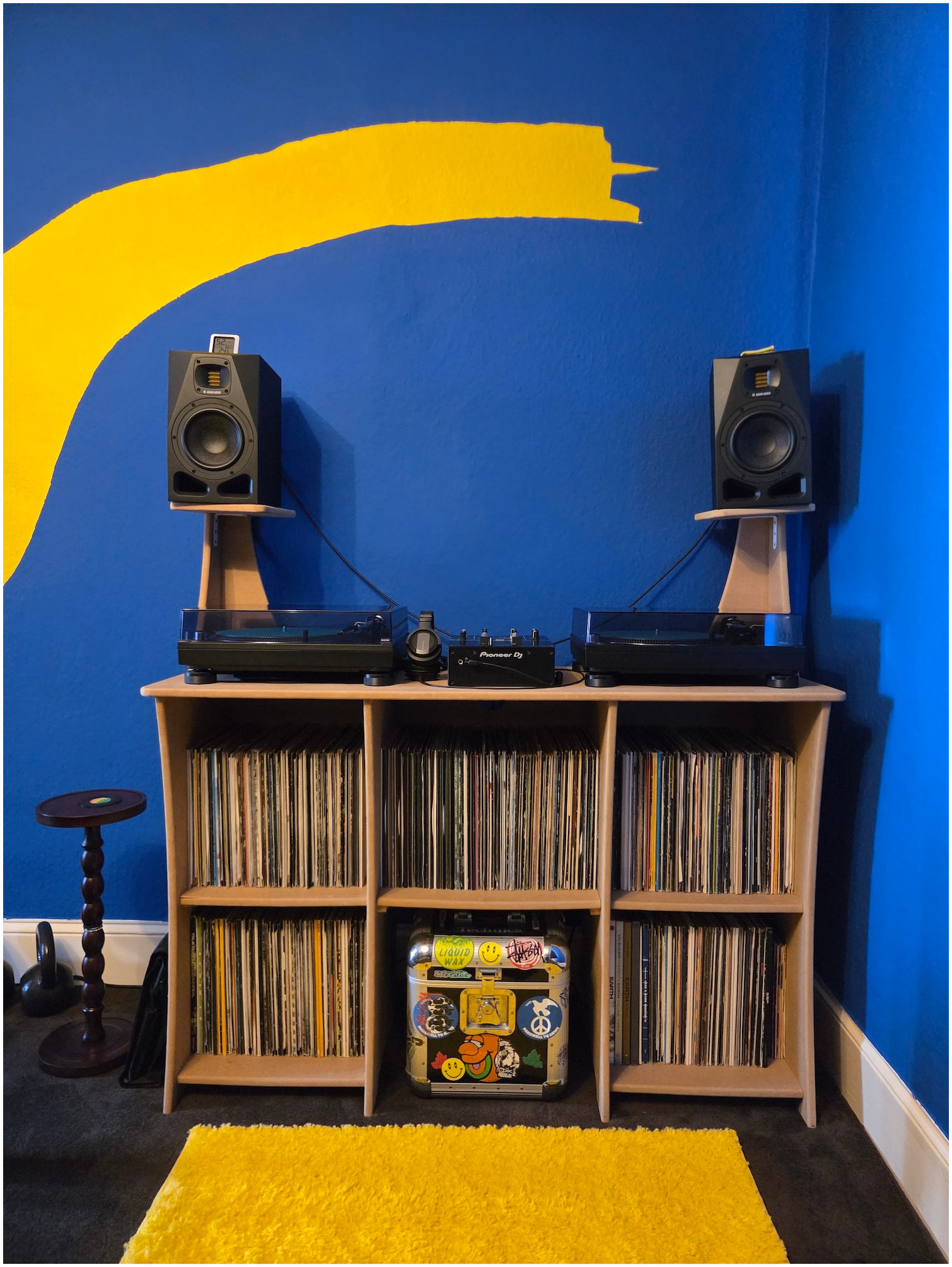
As an indie, I am drawn to the warmth and feel of vinyl (not a 'perfect' sound); the audio romance of a rushing, atmospheric d'n'b break with ethereal soundscapes and melodic breakdowns, which another person will not understand (or like), hits me while a complete stranger will similarly be moved to tears likewise for reasons neither of us understand… other than it makes us human (and connected). For reasons unknown, I find a degree of believability in the DIY, makeshift approach of early cinema to create its effects (films such as The Invisible Man), which leave gaps to be filled by the imagination; as opposed to the explicit, gamer aesthetic (not to mention infantile dialogue) of those ubiquitous green screen movies that leave room for zip. I wonder, in attempts to perfect film-making through technology, are we not destroying it? I don’t know why the gnarled oaks of Dartmoor woodland soothe my restless mind and I don’t care to know why: being in that space, in that moment, requires nothing more as I reconnect with my inner soul.
Contrary to reason, art dwells in a vast lake of not-knowing, what Rudolf Otto referred to as the ‘non-rational’ (as opposed to irrational) state of being. If we shut out the unknowing of the non-rational, do we not reduce ourselves to little more than soporifically obedient automatons? It's interesting to note scientist, J.D. Bernal’s The World, the Flesh and the Devil (written a century ago) not least in his remarkably imaginative, somewhat terrifying vision for the evolution of the human body into something barely recognisable living inside an asteroid. Our current increasingly disembodied world is turning out rather different in its imaginative capacities! My beef with neoliberalism is that it seems to have perpetuated an interminably banal era of soft-totalitarianism spearheaded by governments and Big Tech. Utopian nerds (and indeed many scientists) appear to have a depressingly limited idea of what makes us human (and our potential).
No doubt Theodor Adorno was being a bit of a cultural snob when writing The Stars Down to Earth (and maybe just a tad literal in his interpretation of Freud while perhaps reading too much into something most people take with a pinch of salt), but he was nevertheless on to something in terms of irrationality in a capitalist society. I think we can certainly see ‘the dangers’ he predicted playing out through the mind-numbingly conformist hyper-irrationality of social media and its godawful mix of incessantly uniform slop, paranoia, narcissism, stupidity, depravity and intolerance: dispiriting times!
As Japanese filmmaker, Hayao Miyazaki, said in response to advances in AI and technology: ‘We humans are losing faith in ourselves’. It’s a trite observation to say that technology can be used to great effect in art and culture. It’s as banal as that tedious question: ‘what is art?’ I think maybe it's time to ask what (or rather who) makes art? In a deeply troubled and divided world, the arts can restore faith in humanity. Take the human out and I feel we could be, to quote Hayao Miyazaki, ‘nearing the end of times’.
Resistance through re-enchantment.
2026
© Christopher Sharp