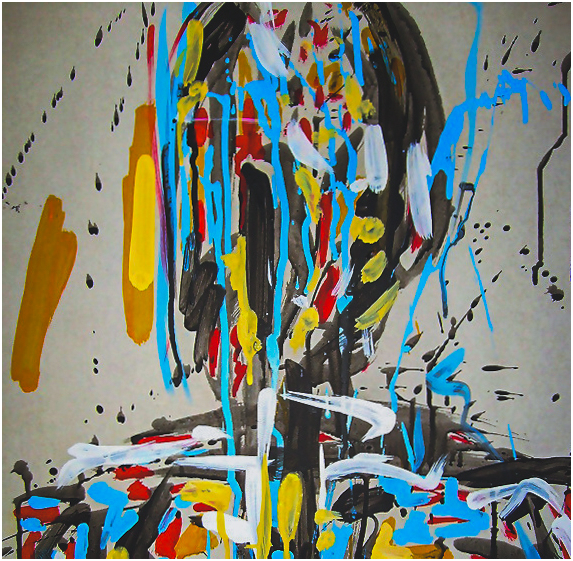
‘The world will ask who you are, and if you do not know, the world will tell you.’ ~ Carl Jung
pseudoscience
I began studying a master’s in psychology while living in Exmouth and switching jobs to an NHS crisis house in Exeter. However, I got halfway through and found the whole subject rather soulless and overly feminised. Indeed, I learned that 96% of psychological research is done in Western countries, predominantly American universities, whose participants are mostly white, female students from relatively affluent backgrounds. So much for diversity (almost as bad as the arts!). I also took issue with its claim to science through a comparatively lax p-value. I found it too much of a chore studying a master’s around full-time shift work in the NHS, which involved hours of reading dry academic journals where I felt the ‘research’ was telling me shit that was self-evident (for certain, my years working in mental health have taught me more about the pervasive nature of despair than anything I’ll learn at university!). During this time, my money-grabbing landlord decided to evict us so he could develop his property into luxury flats. The stress led to being prescribed anti-depressants by my doctor… not for the first time, although this one actually worked (for a while).
I moved to the small village of Tedburn St. Mary (where I reside as of writing, shortly before moving again to Teignmouth: where the valley I grew up meets the sea, I have a view of distant clouds beyond its horizon and can feel the sand beneath my feet). I then read an interview with German film maker, Werner Herzog, who was critical of psychoanalysis. I can’t recall the exact way he put it, but he alluded to the soul as being like a house – if every part of it was illuminated, it would be uninhabitable. He considered it to be equally true of the soul that some darkness is necessary, which runs contrary to the aim (in his opinion) of psychoanalysis. I found myself agreeing with him, which made me realise that if I agree with such a view then I am probably not going to make a very good therapist. It’s oddly reflective of how art has lost its implicit qualities: these days, everything needs to be explained! I faced up to the fact that I had simply lost the confidence to pursue dreams of being a writer (after more rejections for Adrift in Amnesia and The Cycle Diaries than I care to count!). I jacked in the master’s and got back to work.
An art student in the early noughties, I was initially optimistic about Big Tech’s brave new world connecting us all. For a time, this seemed to have real potential – finally releasing creatives from the shackles of the gatekeepers, ushering in a new era of indie. I collaborated with artists, writers and musicians as far afield as the US, Russia and Thailand, but also connected with people who were simply interested in art and were drawn to my work. However, in the last 10-15 years, something has darkened to the point of being weirdly uniform, insular and polarised (curiously coinciding with the rise of iPhones and social media colonising our lives). The nineties feel like a distant memory. Britain no longer feels like a creative country. There is no joy in our disembodied tech malaise. Now is surely one of the most depressing times to be a writer (and artist)… be it facing the totalitarianism of AI, the abject and perpetual nihilism of the Internet, the Americanisation of everything, the absurdity of a pathologically ecocidal and banal consumerism (not least in its commodification of protest), or the mind-numbing conformity of a bourgeois arts scene kowtowing to the egocentric demands of entitled, terminally online activists: cultural homogenisation jacked up to the max in a linear society mistaking lack of collective renewal for diversity.
It feels like we’re in the winter of humanity, unconsciously consuming ourselves into nihility in the pursuit of something unimaginatively meaningless – like a bad dream. Dark satanic mills, in all their destruction of nature and human relationships, have since been replaced by server farms and data centres. Sinister in its anodyne aloofness, a restless hum pervades humankind fragmented globally via the hypnotic radiance emanating from millions of screens serving an all-seeing eye: a prophet for the annihilation of all that is beautiful.
2026
© Percival Alexander